
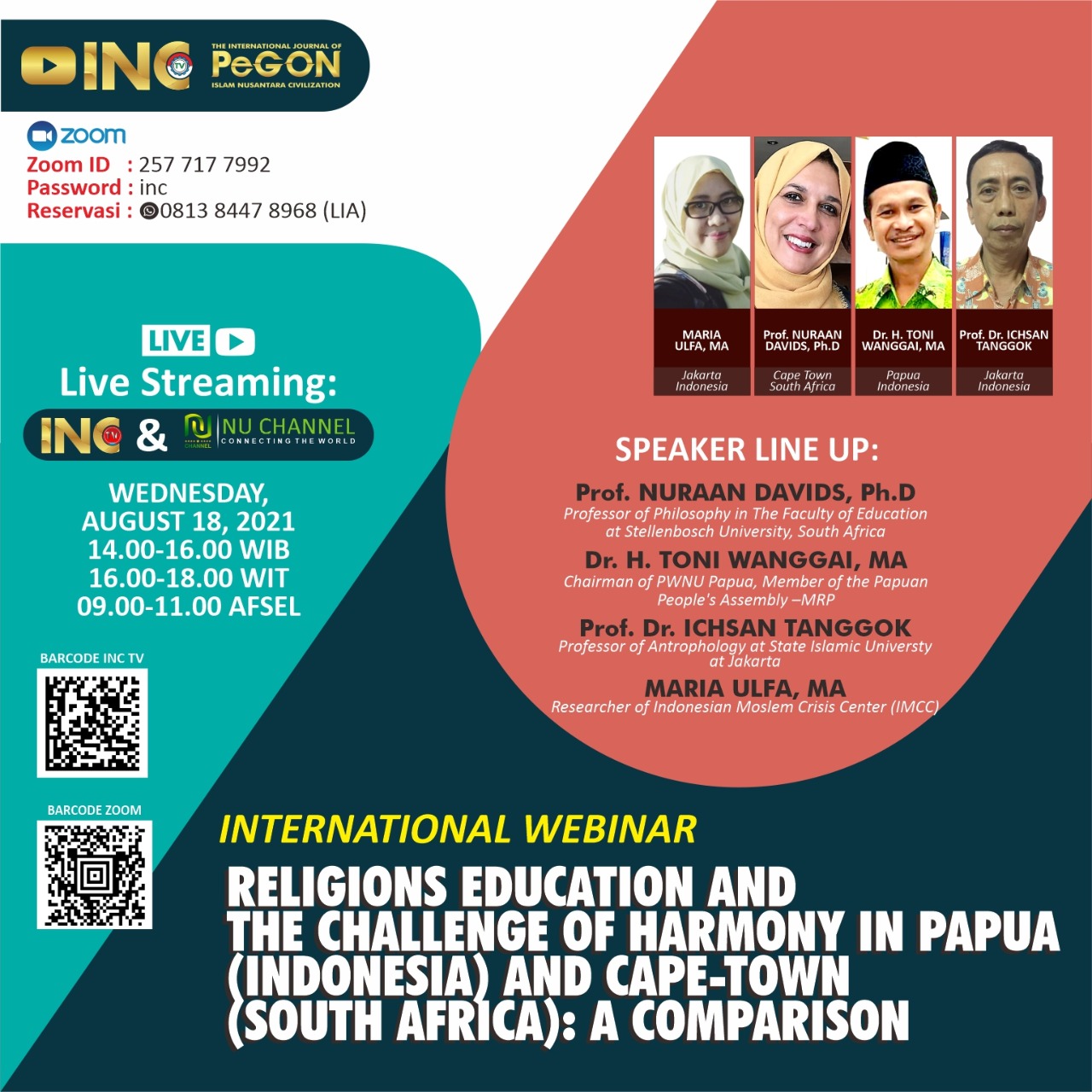
Jaringansantri. In Papua, religion is an important part of the socio-cultural system of society which is based on the principle of “three stoves one stone”, namely the “furnace” of government, adat, and religion. “Three furnaces” is also commonly associated with the three religions; Islam, Christianity and Catholicism. To maintain this principle, the pattern of education applied is an important way for its sustainability, especially in building harmonization of life. Through education, the values of togetherness and brotherhood on the basis of humanity are inherited and taught to new generations in Papua.
In this contexs, INC TV and NU Channel again held an international webinar entitled “Religions Education and the challenge of harmony In papua-indonesia and cape-town-south Africa: A comparison.” In its release, this webinar is intended so that the international community does not see Indonesia, especially Papua, as a country full of violence, tense and full of conflict. However, it has actually fostered a spirit of unity and harmony among the people, especially the younger generation and instilled values and meaning of religious universalism in human values.
“Specifically, the webinar will also give a positive picture that the people of Papua, Indonesia and Cape Town, South Africa, live in peace and tolerance and have a pattern of education and tradition in resolving conflicts with local wisdom. The idea of religious tolerance is not difficult, because the teachings of each religion teach about mutual recognition and respect for others. Differences in language, religious culture and even ethnicity are acceptable.” explained organizer, Muhammad Wafa.
The event was combined with the experience in Cape Town, South Africa because they share a common life full of diversity and share the same challenges in building harmony and tolerance. As stated in the flyer distributed, this International Webinar activity will be live on INC TV Youtube Channel and NU Channel Live Streaming on Wednesday, July 18 2021, 14.00 WIB (16.00 WIT) or 09.00 South Africa Cape Town Time. While the speakers include Prof. Nuraan Davids PhD, (Professor of Philosophy of Education in the Department of Poliicy Studies at Stellenbosch University, South Africa), Dr. tony Wanggai (Chairman of PWNU Papua, Member of the Papuan People’s Assembly –MRP) and Prof. Dr. Ichsan Tanggok (Professor of Anthropology at UIN Jakarta), and guided by Maria Ulfa, MA (researcher of the Indonesian Muslim Crisis Center).
As a member of the MRP (Papuan People’s Assembly), when confirmed, Dr. Tony Wanggai stated that the implementation of Papuan community harmony prioritizes a cultural approach. He gives an example of the 90-60 rule in the case that the construction of houses of worship is not strictly enforced. Tony gave an example that the construction of churches by certain denominations often does not meet the requirements of 90 users, but church establishments still get recommendations because the approach used is a family approach. Likewise, in the construction of mosques and prayer rooms, it is more important to consider aspects of the needs of the people than applying normative rules.
This cultural approach continues to be passed down through various channels, especially education. According to anthropologist Ikhsan Tanggok, Islamic educational institutions under Nahdatul Ulama (NU), Muhammadiyah and the Islamic Education Foundation (YAPIS) have an important role in uniting various ethnic groups, cultures, languages and religions.
“Islamic educational institutions are not only a forum for the Papuan people to study, but also as a forum to unite Papuans from various ethnic groups, cultures and religions. These schools and universities also function as their forum for mutual respect for differences in ethnicity, cultures, languages and religions. Schools and Universities under Islamic organizations and Islamic Foundations in Papua and West Papua have never prohibited Papuans who are not Muslim to study at the schools and universities they manage. They are all treated the same, they have same responsibilities and rights.” explained the professor of UIN Jakarta.
The same thing happened in Cape Town, South Africa, as stated by a South African scholar, Prof. Nuraan Davids. In support of entrenching and constraining racially and ethnic-based segregated communities, apartheid South Africa did not interfere with the religious practices and traditions of diverse groups. Within the public domain of schools, however, the state propagated an Afrikaner form of Calvinistic principles. For practical purposes all public schooling embraced a Christian ethos, with no regard for any religious or cultural diversity.
“In affirming this diversity, recognition is afforded to a variety of major world faiths, an enduring indigenous religious heritage, as well as those citizens who draw their ethical principles and human values from sources other than religion. The constitutional imperative of promoting mutual regard and peaceful co-existence, is made manifest in the National Policy on Religion and Education. In this regard, the teaching of religion education in schools is seen as inextricably aligned to the constitutional values of citizenship, human rights, equality, freedom from discrimination, and freedom of conscience, religion, thought, belief, and opinion. State-funded schools are tasked with the educational responsibility of teaching about religions in ways that are different from religious instruction and fostering that might unfold in the home or faith community.” explained the Professor of Philosophy of Education in the Department of Picy Studies at Stellenbosch University, South Africa.
No responses yet